Epithalon vs FOXO4-DRI: Telomerase Activation vs Senolytic Peptide Comparison for Longevity Research
Executive Summary
Epithalon and FOXO4-DRI represent two distinct approaches to cellular anti-aging research. Epithalon, a synthetic tetrapeptide based on pineal gland epithalamin, activates telomerase to maintain or extend telomeres—the protective caps on chromosomes that shorten with age. FOXO4-DRI is a senolytic peptide that selectively induces apoptosis in senescent ('zombie') cells that accumulate with age and secrete harmful inflammatory factors. While Epithalon aims to preserve cellular replicative capacity, FOXO4-DRI eliminates damaged cells that resist normal death. These represent complementary anti-aging strategies: maintaining healthy cells (Epithalon) versus removing harmful ones (FOXO4-DRI).
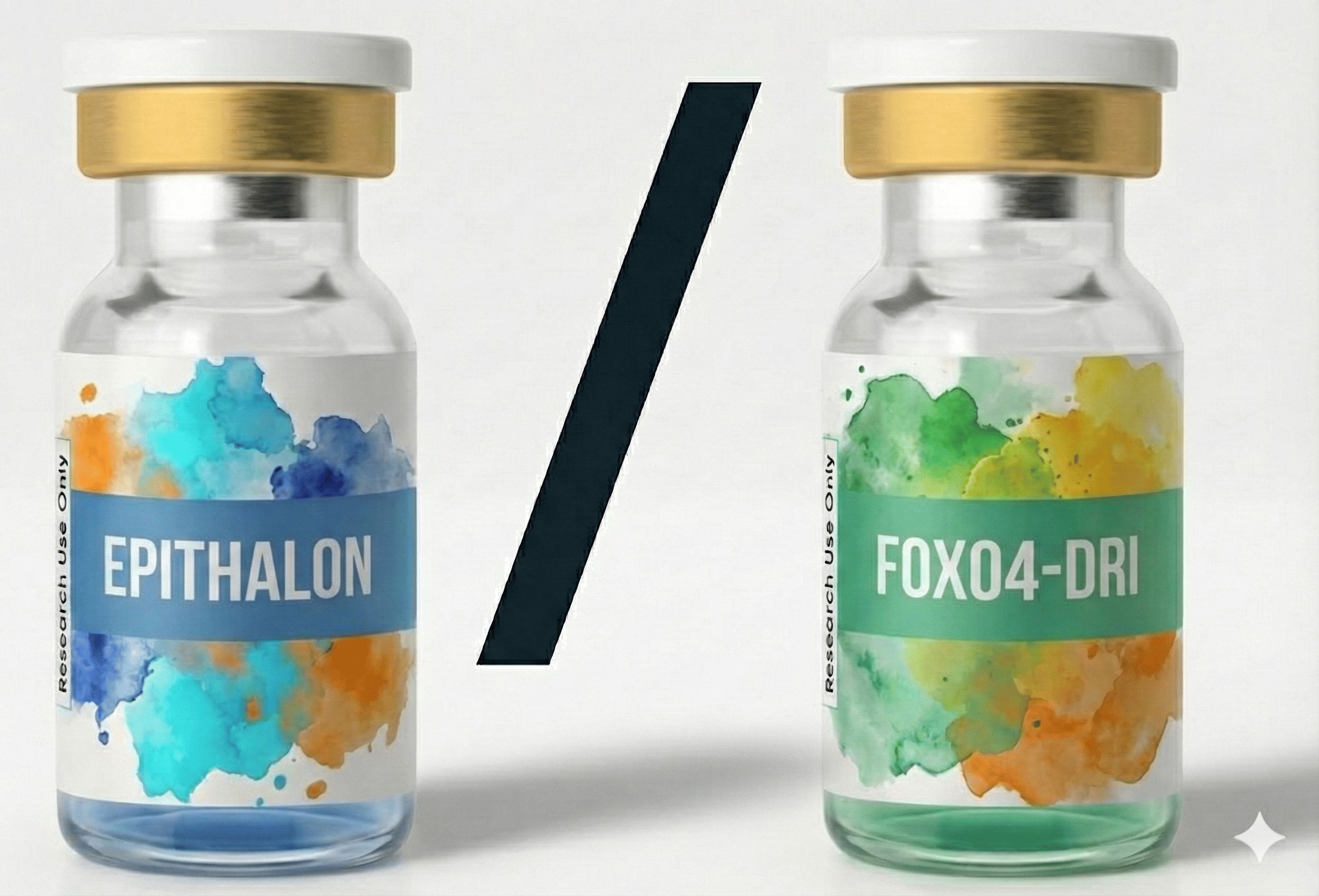
Peptide Profiles
Head-to-Head Comparison
| Property | Epithalon | FOXO4-DRI |
|---|---|---|
| Anti-Aging Strategy | Telomerase activation | Senescent cell elimination |
| Molecular Formula | C14H22N4O9 | C234H380N76O68S2 |
| Sequence | Ala-Glu-Asp-Gly (tetrapeptide) | D-retro-inverso modified (48 aa) |
| Target | Telomerase enzyme | FOXO4-p53 interaction |
| Cellular Effect | Extends replicative lifespan | Induces apoptosis in senescent cells |
| Research Origin | Russian Academy of Sciences | Erasmus University Rotterdam |
| Development Stage | Preclinical (extensive animal data) | Preclinical (proof-of-concept) |
| Administration | Subcutaneous injection | Subcutaneous/IV injection |
| Treatment Paradigm | Cyclical courses | Periodic senolytic clearing |
| Cost/Complexity | Relatively affordable | Expensive, complex synthesis |
Mechanism of Action Differences
Epithalon and FOXO4-DRI address cellular aging through fundamentally different biological strategies—one protective/restorative, the other eliminative.
Epithalon: Telomere Preservation
Epithalon is a synthetic version of epithalamin, a peptide isolated from the pineal gland:
- Telomerase Activation: Increases activity of telomerase, the enzyme that maintains and extends telomeres
- Telomere Protection: Telomeres are protective DNA caps that shorten with each cell division; their shortening limits replicative lifespan
- Melatonin Regulation: May normalize melatonin production through pineal gland effects
- Antioxidant Enhancement: Reported to increase antioxidant enzyme activity
- Philosophy: Keep existing cells healthy and capable of continued division
FOXO4-DRI: Senescent Cell Elimination
FOXO4-DRI is a D-retro-inverso peptide designed to disrupt a specific protein interaction:
- FOXO4-p53 Disruption: Interferes with the binding of FOXO4 to p53, which normally keeps senescent cells alive
- Selective Apoptosis: When the FOXO4-p53 interaction is blocked, p53 is freed to trigger apoptosis specifically in senescent cells
- Senescent Cell Definition: Cells that have stopped dividing but resist death, accumulating with age and secreting inflammatory factors (SASP)
- D-Retro-Inverso Design: Modified peptide backbone provides protease resistance and cell penetration
- Philosophy: Eliminate damaged cells that harm surrounding tissue through inflammatory secretions
Complementary Approaches: Epithalon maintains healthy cell function; FOXO4-DRI removes dysfunctional cells. Used together (theoretically), they could address both preservation of healthy cells and elimination of harmful senescent cells.
Comparative Research Data
Epithalon Research (Khavinson et al.)
Epithalon has extensive preclinical data, primarily from Russian research groups:
- Lifespan Extension: Multiple animal studies show 10-30% lifespan extension in rodents and other models
- Telomerase Activation: Demonstrated activation in human cell cultures and animal tissues
- Immune Function: Improvements in aged immune parameters in animal studies
- Melatonin Normalization: Restoration of circadian melatonin patterns in aged animals
- Cancer Consideration: Some studies suggest reduced tumor incidence despite telomerase activation
FOXO4-DRI Research (de Keizer et al.)
FOXO4-DRI has proof-of-concept data from the initial Dutch research:
- Senescent Cell Clearance: Demonstrated selective killing of senescent fibroblasts in vitro
- In Vivo Effects: Improved fur density, renal function, and fitness in naturally aged mice
- Chemotherapy Recovery: Enhanced recovery in mice treated with doxorubicin (which induces senescence)
- Selectivity: Did not induce apoptosis in normal, non-senescent cells
- Limited Data: Far less extensive research history than Epithalon
Comparative Limitations
Neither peptide has advanced to human clinical trials for aging indications:
- Epithalon: Extensive animal data but limited Western scientific validation
- FOXO4-DRI: Strong mechanistic rationale but only proof-of-concept studies
- Both: No human efficacy or long-term safety data for anti-aging applications
Safety and Tolerability Profile
Epithalon Safety Considerations:
- Long Research History: Decades of Russian research suggests good tolerability in animal studies
- Telomerase Concern: Theoretically, telomerase activation could promote cancer; however, animal studies suggest possible protective effects
- No Serious AEs Reported: Available literature does not report significant adverse events
- Human Data Limited: No rigorous Western clinical trials for safety evaluation
- Cyclical Use: Typically administered in cycles (e.g., 10 days on, extended off) to avoid continuous telomerase stimulation
FOXO4-DRI Safety Considerations:
- Selectivity Critical: Designed for selective action on senescent cells only
- Proof-of-Concept Data: Limited to mouse studies; no human safety data
- Apoptosis Induction: Must confirm selectivity extends to human tissues and doesn't affect healthy cells
- Complex Molecule: D-retro-inverso peptides are complex to synthesize; quality control critical
- Unknown Long-term Effects: Consequences of repeated senescent cell clearing unknown
General Caution: Both peptides are experimental with limited human safety data. The theoretical benefits of anti-aging interventions must be weighed against unknown long-term risks.
Research Verdict: Different Tools for Cellular Aging
Choose Epithalon When Research Focuses On:
- Telomerase biology and telomere maintenance
- Replicative senescence prevention
- Pineal gland and melatonin research
- Accessible, well-characterized peptide with long research history
- Lower cost and simpler synthesis
Choose FOXO4-DRI When Research Focuses On:
- Senescent cell biology and SASP (senescence-associated secretory phenotype)
- Senolytic intervention strategies
- FOXO4-p53 interaction disruption
- Novel senolytic mechanism distinct from small molecule senolytics
- Proof-of-concept studies requiring selective senescent cell targeting
Theoretical Combination: The two approaches are mechanistically complementary—maintaining healthy cells (Epithalon) while eliminating harmful senescent cells (FOXO4-DRI). However, no research has evaluated combined use, and the complexity of aging biology suggests caution with any intervention combination.
Current Reality: Both remain experimental research compounds. Epithalon has more extensive (though primarily Russian) research history. FOXO4-DRI has strong mechanistic rationale but limited experimental validation beyond proof-of-concept. Neither is approved for human use in any jurisdiction.
Frequently Asked Questions
Can Epithalon and FOXO4-DRI be used together for anti-aging?
While theoretically complementary—Epithalon maintaining telomere length in healthy cells while FOXO4-DRI eliminates senescent cells—no research has evaluated combined use. The complexity of aging biology and potential interactions between telomerase activation and senescent cell clearance suggests caution. Any combination protocol would be entirely experimental without supporting data.
Is Epithalon safe given concerns about telomerase and cancer?
Telomerase activation raises theoretical cancer concerns since cancer cells often reactivate telomerase. However, Epithalon animal studies paradoxically suggest possible anti-tumor effects, possibly through improved immune function or DNA repair. The peptide is typically used in cycles rather than continuously. No rigorous human safety trials have been conducted, so the actual cancer risk in humans remains unknown.
How does FOXO4-DRI differ from other senolytics like dasatinib or fisetin?
FOXO4-DRI is a peptide that specifically disrupts the FOXO4-p53 interaction keeping senescent cells alive, while small molecule senolytics like dasatinib and fisetin work through different mechanisms (tyrosine kinase inhibition and flavonoid-mediated effects). FOXO4-DRI's peptide nature provides high specificity but also challenges including cost, synthesis complexity, and delivery. Small molecule senolytics are more accessible but may have broader off-target effects.
Citations & References
Khavinson VK, Izmaylov DM, Obukhova LK, et al.
Mechanisms of ageing and development (2000)
Baar MP, Brandt RMC, Putavet DA, et al.
Cell (2017)
Follow Peptpedia on Google
Add Peptpedia as a Preferred Source and Google can highlight our links with a "preferred" badge in your Top Stories and AI Overviews.