Hexarelin vs Ipamorelin: GHRP Potency vs Selectivity Comparison for Research
Executive Summary
Hexarelin and Ipamorelin represent opposite ends of the GHRP spectrum: maximum potency versus maximum selectivity. Hexarelin is the most potent GHRP for acute GH release but carries significant off-target effects including cortisol and prolactin elevation, rapid desensitization, and potential cardiac activity. Ipamorelin is the most selective GHRP, producing clean GH release without affecting cortisol, prolactin, or appetite, but with lower acute potency. For pure GH research, Ipamorelin is preferred; for studies requiring maximum GH spike or cardiac research, Hexarelin has unique properties.
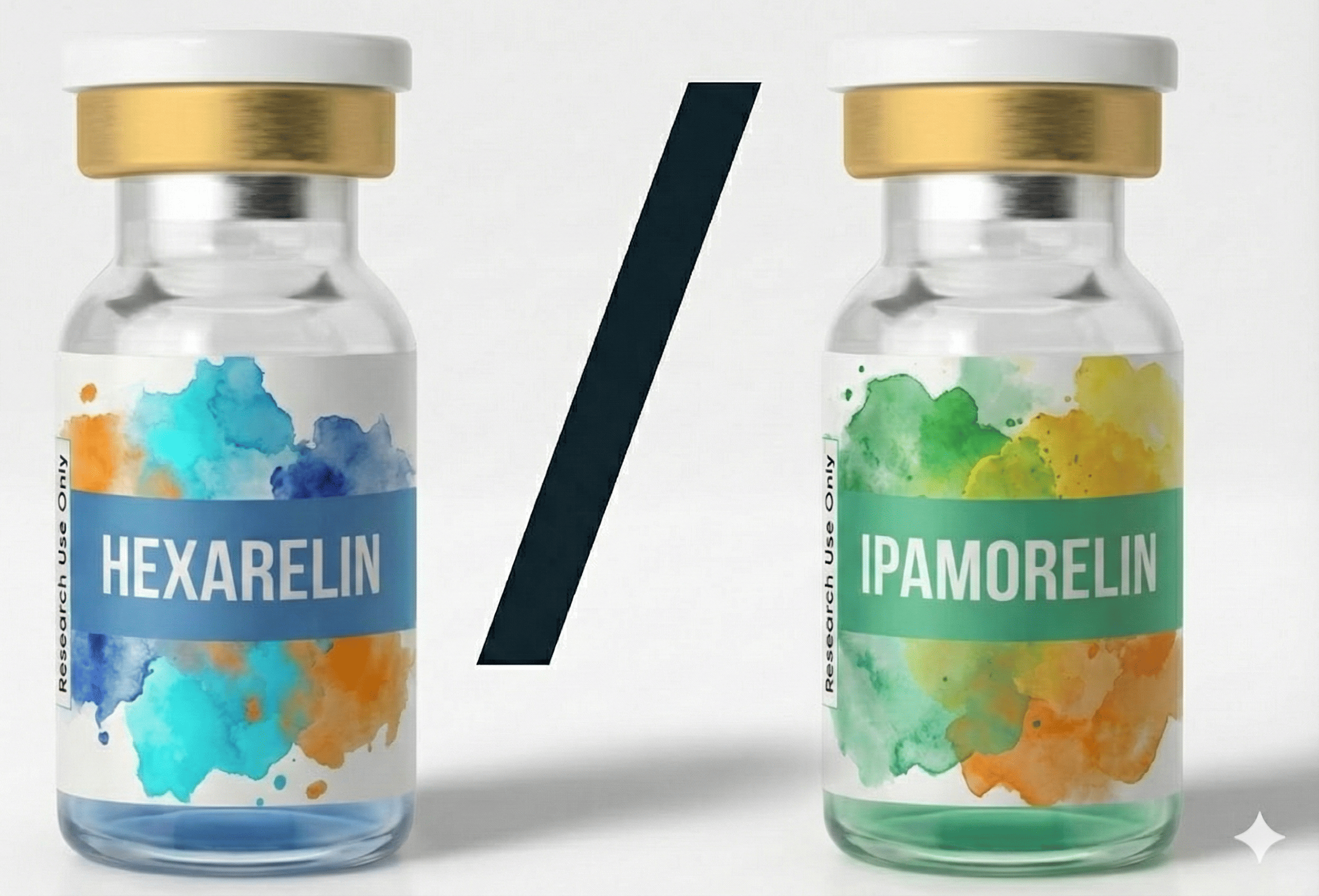
Peptide Profiles
Head-to-Head Comparison
| Property | Hexarelin | Ipamorelin |
|---|---|---|
| Drug Class | Growth Hormone Releasing Peptide | Selective GHRP |
| Molecular Formula | C47H58N12O6 | C38H49N9O5 |
| GH Potency | Highest (most potent GHRP) | Moderate (selective) |
| Effect on Cortisol | Significant increase | No significant effect |
| Effect on Prolactin | Significant increase | No significant effect |
| Appetite Effect | Moderate increase | Minimal effect |
| Desensitization | Rapid (requires cycling) | Minimal |
| Cardiac Effects | Cardioprotective research | None documented |
| Selectivity | Low (multiple effects) | High (GH-specific) |
| Duration of Effect | Diminishes with use | Sustained with continued use |
Mechanism of Action Differences
Hexarelin and Ipamorelin both stimulate GH release through the ghrelin receptor (GHS-R1a), but their binding profiles and downstream effects differ substantially.
Hexarelin: Maximum Potency, Broad Effects
Hexarelin produces the strongest acute GH release of any GHRP:
- GHS-R1a Activation: High-affinity binding produces powerful GH release
- Cortisol Release: Significant ACTH and cortisol elevation (stress hormone activation)
- Prolactin Elevation: Increases prolactin levels, potentially problematic for some applications
- Appetite Stimulation: Moderate ghrelin-like hunger effect
- Cardiac Activity: Unique cardioprotective effects through cardiac GHS receptors
- Desensitization: Rapid tolerance development; effects diminish within 2-4 weeks of continuous use
Ipamorelin: Maximum Selectivity
Ipamorelin was designed specifically for selective GH release:
- GHS-R1a Selectivity: Activates only GH-releasing pathways at the receptor
- No Cortisol Effect: Does not stimulate ACTH or cortisol release
- No Prolactin Effect: Does not affect prolactin levels
- Minimal Appetite Effect: Unlike other GHRPs, does not significantly increase hunger
- No Cardiac Activity: Lacks Hexarelin's cardiac receptor effects
- No Desensitization: Effects maintain with continued use
Key Trade-off: Hexarelin offers maximum acute GH release but with hormonal side effects and rapid desensitization. Ipamorelin offers consistent, selective GH release without confounding effects. For most GH research, Ipamorelin's selectivity is preferred.
Comparative Efficacy and Unique Properties
GH Release Comparison
Head-to-head assessments show:
- Acute Potency: Hexarelin produces higher peak GH levels than Ipamorelin
- Sustained Efficacy: Ipamorelin maintains effects; Hexarelin diminishes within weeks
- Long-term Use: Ipamorelin preferred for protocols exceeding 2-4 weeks
- Synergy with GHRH: Both synergize with CJC-1295/Sermorelin
Hexarelin Cardiac Research
Hexarelin has unique cardiac properties:
- Cardiac GHS Receptors: Activates GH secretagogue receptors in heart tissue
- Cardioprotection: Demonstrated protective effects in ischemia/reperfusion models
- LV Function: Improved left ventricular function in heart failure research
- Unique Among GHRPs: These cardiac effects are not shared by Ipamorelin
Research Application Differences
Application-specific preferences:
- Pure GH Research: Ipamorelin (clean signal, no confounding)
- Cardiac Research: Hexarelin (unique cardiac effects)
- Long-term Protocols: Ipamorelin (no desensitization)
- Acute Maximal GH: Hexarelin (highest peak, short-term only)
Safety and Tolerability Profile
Hexarelin Safety Profile:
- Cortisol Elevation: Significant; may produce stress-like metabolic effects with chronic use
- Prolactin Increase: May affect reproductive hormones; gynecomastia concerns
- Desensitization: Requires cycling (on/off periods) to maintain effectiveness
- Appetite Increase: Moderate hunger stimulation
- Cardiac Effects: Generally cardioprotective, but effects on cardiac function should be considered
Ipamorelin Safety Profile:
- Selective Profile: No cortisol, prolactin, or significant appetite effects
- Well-Tolerated: Generally the best-tolerated GHRP
- No Desensitization: Can be used continuously without cycling
- Head Rush: Some reports of transient lightheadedness post-injection
- Water Retention: Possible GH-related fluid retention with any GHRP
Comparative Safety: Ipamorelin has the cleanest safety profile of any GHRP. Hexarelin's potency comes with significant hormonal side effects and the need for cycling. For research requiring extended administration, Ipamorelin is strongly preferred.
Research Verdict: Power vs. Precision
Choose Hexarelin When:
- Cardiac research is the primary focus (unique cardioprotective effects)
- Maximum acute GH release is needed for short-term studies
- Cycling protocols are acceptable
- Hormonal side effects can be monitored and managed
Choose Ipamorelin When:
- Clean GH signal without confounding hormonal effects is essential
- Long-term or continuous protocols are planned
- Cortisol and prolactin effects must be avoided
- Combination with CJC-1295 for synergistic effects
- Research requires repeatable, consistent GH stimulation
Evolution of GHRPs: Hexarelin represents the "first-generation" goal of maximum GH potency. Ipamorelin represents the refined goal of selective GH release. For most modern GH research, Ipamorelin's selectivity makes it the preferred GHRP, typically combined with CJC-1295 for synergistic effects.
Hexarelin's Niche: Despite its side effects, Hexarelin retains value for cardiac research and short-term studies requiring maximum GH spike. Its unique cardiac receptor activity is not replicated by other GHRPs.
Frequently Asked Questions
Why is Hexarelin more potent but less popular than Ipamorelin?
Hexarelin produces the strongest acute GH release of any GHRP, but this potency comes with significant drawbacks: cortisol and prolactin elevation, appetite stimulation, and rapid desensitization requiring cycling. Ipamorelin, while less potent per dose, produces clean GH release without these side effects and maintains efficacy with continuous use. For most research applications, Ipamorelin's selectivity and sustained effectiveness outweigh Hexarelin's higher peak GH release.
Is Hexarelin useful for anything other than GH release?
Yes, Hexarelin has unique cardioprotective effects not shared by other GHRPs. Research has shown it activates GH secretagogue receptors in cardiac tissue, providing protection against ischemia/reperfusion injury and improving left ventricular function in heart failure models. This makes Hexarelin valuable for cardiac research even when its GH effects are not the primary focus.
How long can Ipamorelin be used continuously vs. Hexarelin?
Ipamorelin can be used continuously without significant desensitization—its effects maintain over extended periods. Hexarelin, in contrast, shows diminishing returns within 2-4 weeks of continuous use and requires cycling (periods of use followed by breaks) to maintain effectiveness. This makes Ipamorelin preferred for any protocol requiring consistent GH stimulation over weeks to months.
Citations & References
Locatelli V, Rossoni G, Schweiger F, et al.
Endocrinology (1999)
Raun K, Hansen BS, Johansen NL, et al.
European Journal of Endocrinology (1998)
Follow Peptpedia on Google
Add Peptpedia as a Preferred Source and Google can highlight our links with a "preferred" badge in your Top Stories and AI Overviews.