Semaglutide vs Tirzepatide: Comparative Analysis of GLP-1 Receptor Agonist Efficacy for Weight Loss and Glycemic Control
Executive Summary
Research indicates that Tirzepatide, a dual GIP/GLP-1 receptor agonist, demonstrates superior weight loss efficacy compared to Semaglutide, a GLP-1-only agonist, in head-to-head clinical trials. The SURMOUNT-5 trial showed Tirzepatide achieved 20.2% average body weight reduction versus 13.7% for Semaglutide at 72 weeks—a 47% greater relative weight loss. Both compounds show comparable gastrointestinal tolerability profiles, but Tirzepatide's dual mechanism appears to provide synergistic metabolic benefits through simultaneous activation of glucose-dependent insulinotropic polypeptide (GIP) and GLP-1 pathways.
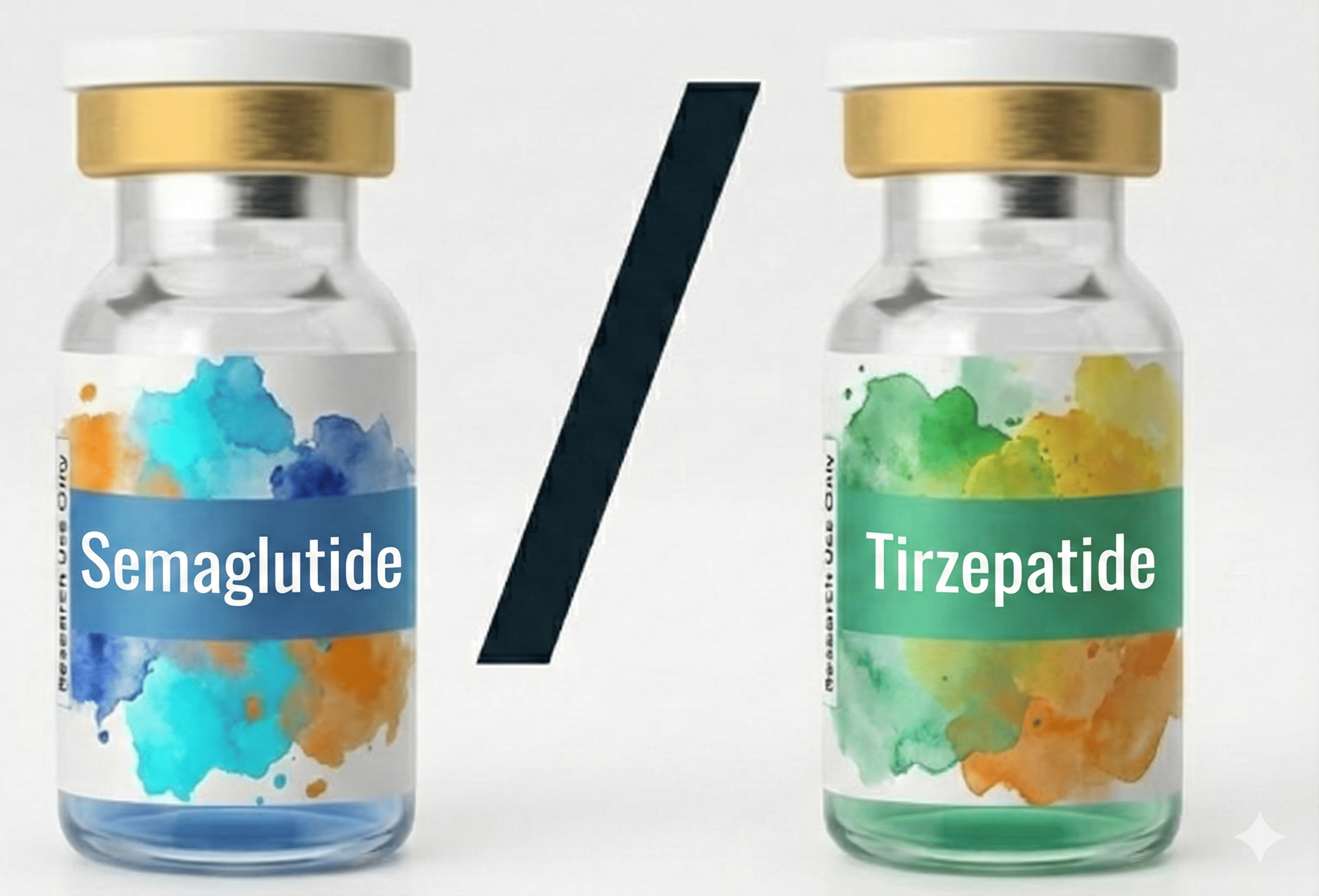
Peptide Profiles
Head-to-Head Comparison
| Property | Semaglutide | Tirzepatide |
|---|---|---|
| Drug Class | GLP-1 Receptor Agonist | Dual GIP/GLP-1 Receptor Agonist |
| Molecular Formula | C187H291N45O59 | C225H348N48O68 |
| Molecular Weight | 4,113.58 g/mol | 4,813.45 g/mol |
| Administration | Once weekly subcutaneous | Once weekly subcutaneous |
| Maximum Dose | 2.4 mg/week (weight loss) | 15 mg/week |
| Half-Life | ~7 days | ~5 days |
| Weight Loss (72 weeks) | 13.7% body weight | 20.2% body weight |
| Mechanism Targets | GLP-1 receptor only | GIP + GLP-1 receptors |
| FDA Approval (Obesity) | Wegovy (2021) | Zepbound (2023) |
| FDA Approval (T2D) | Ozempic (2017) | Mounjaro (2022) |
Mechanism of Action Differences
The fundamental distinction between Semaglutide and Tirzepatide lies in their receptor targeting profiles. Semaglutide functions as a selective GLP-1 receptor agonist with 94% structural homology to native GLP-1, achieving its metabolic effects through a single pathway: activation of GLP-1 receptors in the pancreas, brain, and gastrointestinal tract.
Tirzepatide, in contrast, represents a first-in-class dual agonist that simultaneously activates both GIP (glucose-dependent insulinotropic polypeptide) and GLP-1 receptors. This dual mechanism provides several theoretical advantages:
- Enhanced insulin secretion: GIP and GLP-1 work synergistically on pancreatic beta cells, potentially providing greater glucose-dependent insulin release
- Improved lipid metabolism: GIP receptors are expressed in adipose tissue and may enhance lipid handling and fat oxidation
- Complementary appetite suppression: Both pathways contribute to satiety signaling through distinct but overlapping hypothalamic circuits
- Reduced glucagon secretion: The combination may provide more robust suppression of inappropriate glucagon release
Both peptides are modified with fatty acid chains (C18 for Semaglutide, C20 for Tirzepatide) that enable albumin binding and extend their half-lives to approximately one week, allowing once-weekly administration.
Comparative Clinical Efficacy Data
SURMOUNT-5: Head-to-Head Trial Results
The SURMOUNT-5 trial (NCT05822830) represents the first randomized, head-to-head comparison of Tirzepatide versus Semaglutide in adults with obesity but without diabetes. Published in the New England Journal of Medicine in 2025, this pivotal study enrolled participants with BMI ≥30 kg/m² or ≥27 kg/m² with weight-related comorbidities.
Primary Endpoint (72 weeks):
- Tirzepatide: -20.2% mean body weight reduction
- Semaglutide: -13.7% mean body weight reduction
- Difference: 6.5 percentage points favoring Tirzepatide (47% greater relative effect)
Weight Loss Threshold Achievement:
- ≥5% weight loss: Both groups achieved high rates
- ≥10% weight loss: Significantly higher with Tirzepatide
- ≥15% weight loss: Significantly higher with Tirzepatide
- ≥20% weight loss: Significantly higher with Tirzepatide
- ≥25% weight loss: Achieved more frequently with Tirzepatide
Real-World Evidence: JAMA Internal Medicine 2024
Rodriguez et al. analyzed 18,386 propensity-matched patients with overweight/obesity in real-world clinical settings:
- At 12 months: Tirzepatide showed 6.9% greater weight loss than Semaglutide
- Hazard ratio for achieving ≥15% weight loss: 3.24 (224% more likely with Tirzepatide)
- Discontinuation rates were similar between groups (52-56%)
- No significant difference in gastrointestinal adverse events
Safety and Tolerability Profile
Both Semaglutide and Tirzepatide share a similar adverse event profile, predominantly involving gastrointestinal symptoms that typically diminish with continued treatment:
Common adverse events (both agents):
- Nausea (most common, typically transient)
- Vomiting
- Diarrhea
- Constipation
- Abdominal pain
- Injection site reactions
Key safety considerations:
- Both carry boxed warnings for thyroid C-cell tumors (based on rodent studies)
- Contraindicated in patients with personal or family history of medullary thyroid carcinoma
- Both contraindicated in MEN2 syndrome
- Risk of pancreatitis requires monitoring
- Dose-dependent GI effects managed through gradual titration
Clinical trials and real-world data suggest no significant difference in the overall tolerability profile between the two agents when properly titrated. The higher efficacy of Tirzepatide does not appear to come at the cost of increased adverse events.
Research Applications and Synergistic Potential
Current research does not support combining Semaglutide and Tirzepatide, as Tirzepatide already incorporates GLP-1 agonism within its dual mechanism. However, both agents are being studied in combination with other therapeutic approaches:
Combination research areas:
- With exercise interventions: Both agents show enhanced outcomes when combined with structured physical activity programs
- With dietary modifications: Caloric restriction and protein intake optimization may enhance lean mass preservation during weight loss
- With behavioral therapy: Cognitive behavioral approaches may improve long-term weight maintenance
Emerging research directions:
- Cardiovascular outcome trials (ongoing for both agents in obesity indication)
- MASH/NAFLD treatment (both showing promise for liver fat reduction)
- Obstructive sleep apnea resolution studies
- Combination with amylin analogs for enhanced satiety
The development of Retatrutide, a triple agonist targeting GLP-1, GIP, and glucagon receptors, represents the next evolution in this therapeutic class and is covered in a separate comparative analysis.
Frequently Asked Questions
Can you combine Semaglutide and Tirzepatide together?
Research does not support combining Semaglutide and Tirzepatide, as Tirzepatide already includes GLP-1 receptor agonism within its dual mechanism. Taking both would duplicate GLP-1 pathway activation without additional benefit, while potentially increasing gastrointestinal side effects. If switching between agents, a washout period is typically recommended.
Which is more effective for weight loss: Semaglutide or Tirzepatide?
Clinical trials demonstrate Tirzepatide produces significantly greater weight loss than Semaglutide. In the SURMOUNT-5 head-to-head trial, Tirzepatide achieved 20.2% average body weight reduction versus 13.7% for Semaglutide at 72 weeks—representing 47% greater relative weight loss with the dual agonist.
Does Tirzepatide have more side effects than Semaglutide?
Clinical trials and real-world data suggest no significant difference in the overall tolerability profile between Tirzepatide and Semaglutide when properly titrated. Both share similar gastrointestinal side effects (nausea, vomiting, diarrhea) that typically diminish with continued use. The higher efficacy of Tirzepatide does not appear to come at the cost of increased adverse events.
Citations & References
Aronne LJ, Horn DB, le Roux CW, et al.
New England Journal of Medicine (2025)
Rodriguez PJ, et al.
JAMA Internal Medicine (2024)
Frías JP, et al.
New England Journal of Medicine (2021)
Wilding JPH, et al.
New England Journal of Medicine (2021)
Follow Peptpedia on Google
Add Peptpedia as a Preferred Source and Google can highlight our links with a "preferred" badge in your Top Stories and AI Overviews.