Semax vs Selank: Nootropic Peptide Comparison for Cognitive and Anxiolytic Research
Executive Summary
Semax and Selank, both developed in Russia for clinical use, represent complementary approaches to cognitive and emotional regulation through peptide therapeutics. Semax, derived from ACTH (4-10), primarily enhances focus, learning, and cognitive performance through BDNF upregulation and dopaminergic modulation. Selank, a synthetic analog of the immunomodulatory peptide tuftsin, provides anxiolytic effects comparable to benzodiazepines without sedation or dependence. While both increase BDNF expression, their receptor profiles and downstream effects differ—Semax activates, while Selank calms. Researchers often combine them for balanced cognitive enhancement with mood stabilization.
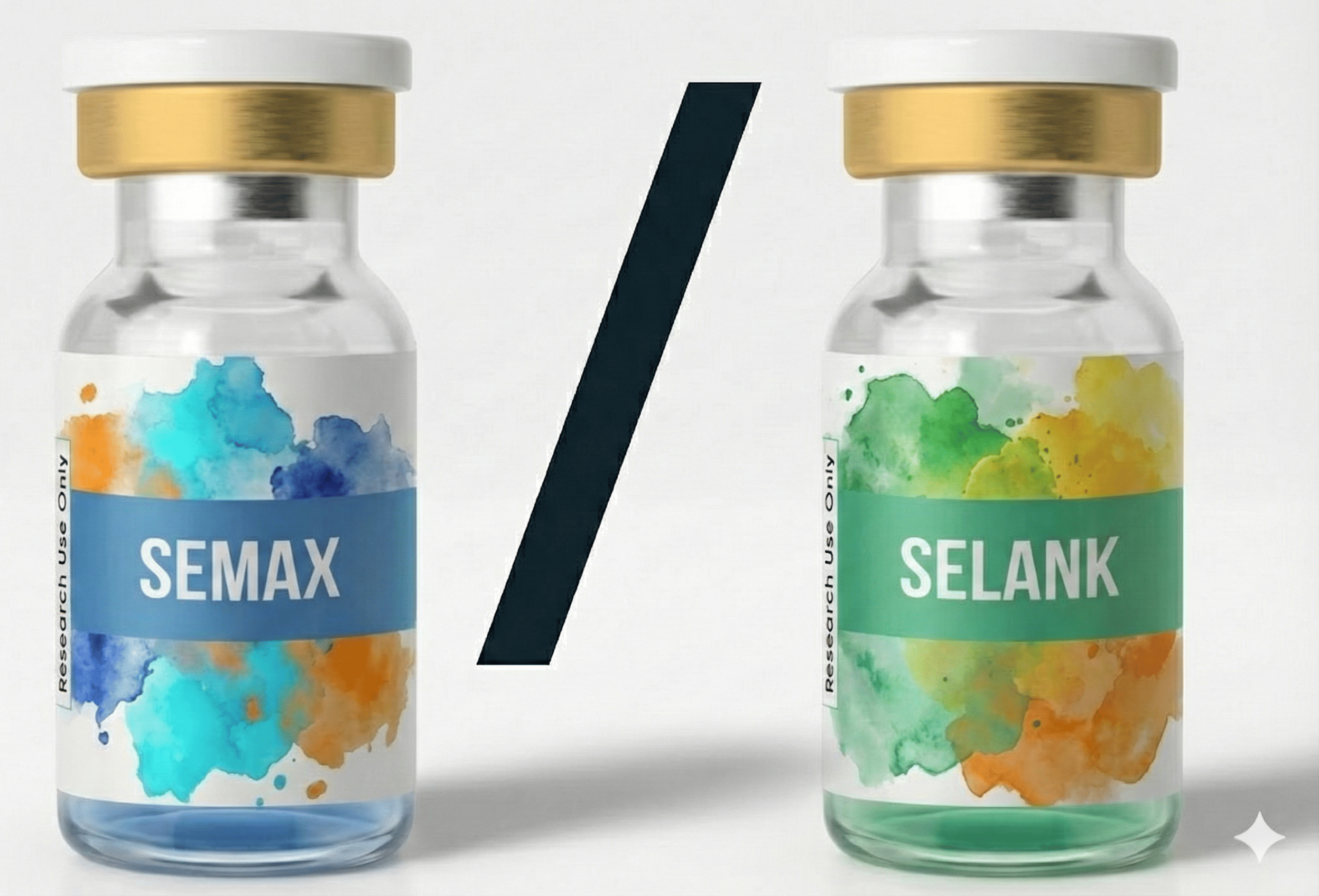
Peptide Profiles
Head-to-Head Comparison
| Property | Semax | Selank |
|---|---|---|
| Origin | ACTH (4-10) fragment derivative | Tuftsin analog |
| Molecular Formula | C37H51N9O10S | C33H57N11O9 |
| Primary Effect | Cognitive enhancement, focus | Anxiolytic, calming |
| BDNF Effect | Strong upregulation | Moderate upregulation |
| Dopamine Modulation | Increases dopaminergic activity | Minimal direct effect |
| GABA Effect | Minimal | Enhances GABAergic signaling |
| Clinical Status (Russia) | Approved medication | Approved medication |
| Administration | Intranasal | Intranasal |
| Onset of Action | Minutes to hours | Minutes to hours |
| Research Focus | ADHD, stroke recovery, learning | Anxiety, PTSD, immunomodulation |
Mechanism of Action Differences
Semax and Selank both modulate brain function through peptide-mediated pathways, but target distinct neurochemical systems with opposite effects on arousal and stress response.
Semax: The Cognitive Activator
Semax is a synthetic heptapeptide derived from an ACTH (adrenocorticotropic hormone) fragment, but it lacks hormonal effects and instead targets the brain's neurotrophic systems. Research in animal models shows that Semax can upregulate brain-derived neurotrophic factor (BDNF) and its receptor TrkB in the hippocampus:
- BDNF Upregulation: Potently increases brain-derived neurotrophic factor expression in hippocampus and prefrontal cortex, supporting neuroplasticity and learning (PMID: 14556513)
- Dopamine Enhancement: Modulates dopaminergic transmission, contributing to improved focus and motivation (PMID: 14556513, PMID: 16996037)
- Serotonin/Norepinephrine: Influences monoamine systems involved in attention and arousal (PMID: 16362768)
- NGF Expression: Increases nerve growth factor, supporting neuronal survival and development (PMID: 16996037)
- No Classical ACTH Effects: Semax lacks the classical peripheral ACTH effects on cortisol release
Selank: The Anxiolytic Stabilizer
Selank is another synthetic peptide (an analog of the immune peptide tuftsin) with a markedly different mode of action. It is often described as anxiolytic (anti-anxiety) and neurotrophic:
- GABAergic Enhancement: Modulates GABA-A receptor-mediated signaling indirectly, acting as a positive allosteric modulator (PMID: 26924987)
- Serotonin Modulation: Influences serotonergic pathways involved in mood regulation (PMID: 26924987)
- Enkephalin Degradation Inhibition: May inhibit enzymes that break down endogenous opioid peptides (PMID: 12432865)
- BDNF Expression: Also increases BDNF, though typically less potently than Semax (PMID: 18841804)
- Immunomodulation: Retains tuftsin's effects on immune function, including cytokine regulation (PMID: 18577961)
Complementary Profiles: Semax provides activating, focusing effects while Selank provides calming, anxiety-reducing effects. The combination may offer cognitive enhancement without overstimulation.
Comparative Clinical and Research Data
Semax Clinical Experience (Russia)
Semax has been used clinically in Russia since the 1990s:
- Stroke Recovery: Approved indication for acute ischemic stroke; studies show improved neurological outcomes (PMID: 29798983, PMID: 11517472)
- Cognitive Enhancement: Used for memory and attention disorders. Preclinical studies show Semax can modulate learning and memory through regulation of the BDNF–TrkB signaling pathway (PMID: 16996037)
- Optic Nerve Disease: Approved for glaucomatous optic neuropathy and has been studied as an adjunct neuroprotective therapy (PMID: 11569188)
- ADHD Research: Studies suggest benefits for attention and hyperactivity symptoms (PMID: 16996699)
Selank Clinical Experience (Russia)
Selank has Russian clinical approval and research history:
- Generalized Anxiety: Approved in Russia for anxiety and stress-related disorders; some studies report anxiolytic efficacy comparable to low-dose benzodiazepines in selected patient populations (PMID: 25176261, PMID: 28280289)
- No Dependence: Does not produce tolerance, dependence, or withdrawal—key advantage over traditional anxiolytics (PMID: 25176261)
- Cognitive Preservation: Unlike benzodiazepines, does not impair memory or cognitive function (PMID: 25176261)
- Immune Support: Used for immune-related conditions given tuftsin heritage (PMID: 18577961)
Comparative Research Findings
Head-to-head and comparative studies suggest:
- Both increase BDNF, and Semax shows greater prefrontal engagement than Selank (PMID: 32342318)
- Selank provides superior anxiolytic effects without the stimulating properties of Semax (PMID: 25176261)
- Combination may provide balanced nootropic effects with mood stabilization
- Neither has completed Western regulatory approval processes
Safety and Tolerability Profile
Semax Safety Profile: (PMID: 36014874, PMID: 35456550)
- Generally Well-Tolerated: Low incidence of adverse events in clinical use
- Potential Overstimulation: Some users report irritability, insomnia, or anxiety at higher doses
- Limited Hormonal Impact: Lacks classical peripheral ACTH effects; no direct PubMed-indexed studies have measured cortisol levels following Semax administration
- Nasal Administration: Local irritation possible but typically mild
- Long-term Data: Decades of Russian clinical experience suggest good safety profile
Selank Safety Profile: (PMID: 25176261, PMID: 28280289)
- Excellent Tolerability: Very few reported adverse events
- No Dependence Risk: Does not produce tolerance or withdrawal—major advantage
- No Sedation: Unlike benzodiazepines, does not cause drowsiness or cognitive impairment
- No Muscle Relaxation: Anxiolytic effects without physical sedation
- Immunomodulatory Effects: May affect immune function; relevance unclear
Combination Considerations: The combination of Semax (activating) and Selank (calming) may provide balanced effects, but formal safety data for combination use is limited to anecdotal reports.
Research Verdict: Activation vs. Calming
Choose Semax When Research Requires:
- Cognitive enhancement and improved focus
- BDNF upregulation for neuroplasticity research
- Neuroprotection in stroke or ischemia models
- Dopaminergic modulation studies
- Learning and memory enhancement
Choose Selank When Research Requires:
- Anxiolytic effects without sedation
- GABAergic modulation without benzodiazepine-type effects
- Stress response attenuation
- Immunomodulatory peptide research
- Non-dependence-forming anxiolytics
Consider Combination When:
- Balanced cognitive enhancement with mood stabilization is desired
- Research subjects may experience overstimulation from Semax alone
- Both neuroplasticity and stress resilience are targets
Regulatory Reality: Both peptides are approved medications in Russia but have not undergone Western regulatory approval. Research use predominates outside Russia, and clinical applications should consider the regulatory landscape in the jurisdiction of use.
Frequently Asked Questions
Can Semax and Selank be used together?
Many researchers and users combine Semax and Selank, as they have complementary mechanisms. Semax provides cognitive activation and focus through dopaminergic and BDNF pathways, while Selank provides calming and anxiolytic effects through GABAergic modulation. The combination may provide balanced nootropic effects with reduced risk of overstimulation. However, no formal clinical studies have evaluated the combination, so protocols are based on anecdotal reports. (PMID: 32342318)
Which is better for anxiety: Semax or Selank?
Selank is the preferred choice for anxiety research. It provides benzodiazepine-like anxiolytic effects without sedation, cognitive impairment, or dependence risk. Semax, being an activating nootropic that enhances dopaminergic activity, may actually increase anxiety in some individuals at higher doses. For anxiety-focused research, Selank is the more appropriate compound. (PMID: 25176261, PMID: 28280289)
Are Semax and Selank approved medications?
Both Semax and Selank are approved prescription medications in Russia, where they have been used clinically since the 1990s. Semax is approved for stroke recovery and cognitive disorders, while Selank is approved for anxiety. However, neither has completed FDA approval in the United States or EMA approval in Europe. Outside Russia, they are primarily used as research compounds.
Semax vs Selank for ADHD: which is better?
Semax is the one with attention-related evidence: studies report benefits for attention and hyperactivity symptoms (PMID: 16996699), and its research focus includes ADHD alongside stroke recovery and learning, whereas Selank's research focus is anxiety, PTSD, and immunomodulation. In Russia Semax is approved for stroke recovery and cognitive disorders — not specifically for ADHD — and neither peptide has completed FDA or EMA approval. For attention-related research questions, the published evidence base sits almost entirely with Semax.
Citations & References
Dolotov OV, et al.
Brain Research Bulletin (2006)
Medvedev VE, et al.
Zhurnal Nevrologii i Psikhiatrii imeni S.S. Korsakova (2014)
Gusev EI, Skvortsova VI, et al.
Zhurnal nevrologii i psikhiatrii imeni S.S. Korsakova (1997)
Volkova A, Shadrina M, Kolomin T, et al.
Frontiers in pharmacology (2016)
Panikratova YR, Lebedeva IS, Sokolov OY, et al.
Doklady biological sciences : proceedings of the Academy of Sciences of the USSR, Biological sciences sections (2020)
Uchakina ON, et al.
Zhurnal nevrologii i psikhiatrii imeni S.S. Korsakova (2008)
Kurysheva NI, et al.
Vestnik oftalmologii (2001)
Follow Peptpedia on Google
Add Peptpedia as a Preferred Source and Google can highlight our links with a "preferred" badge in your Top Stories and AI Overviews.