CJC-1295 vs Ipamorelin: Pulse vs Sustained GH Release
Executive Summary
Ipamorelin starts the GH pulse at the ghrelin receptor (~2-hour half-life); in the rat and swine study that introduced it (PMID 9849822) it released GH without the ACTH and cortisol rise seen with GHRP-6 and GHRP-2. CJC-1295 amplifies GH at the GHRH receptor (minutes without DAC, 6–8 days with DAC). They are complementary, not substitutes — a GHRP initiator plus a GHRH amplifier. Neither is FDA-approved; combination use rests on receptor pharmacology, not a published head-to-head trial.
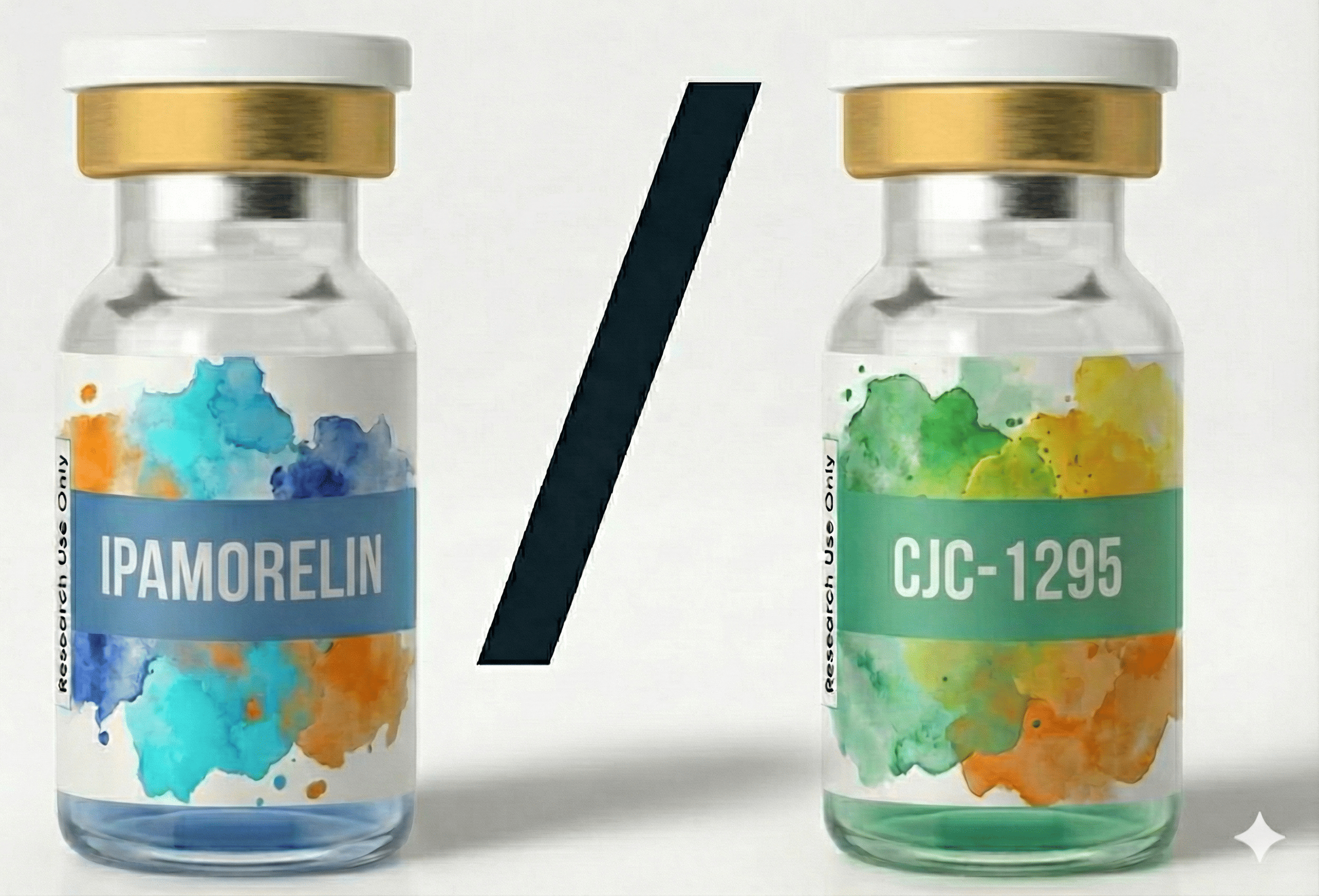
Peptide Profiles
Head-to-Head Comparison
| Property | CJC-1295 | Ipamorelin |
|---|---|---|
| Drug Class | GHRH Analog | Selective GHRP (Ghrelin Mimetic) |
| Molecular Formula | C152H252N44O42 | C38H49N9O5 |
| Primary Receptor | GHRH Receptor | GHS-R1a (Ghrelin Receptor) |
| Mechanism | Amplifies GH release signal | Initiates GH release pulse |
| GH Release Pattern | Sustained elevation | Acute pulse |
| Effect on Cortisol | None | No rise above GHRH control (swine, PMID 9849822) |
| Effect on Prolactin | None | None — as with every GHRP tested in that study |
| Effect on Appetite | None | Minimal (selective) |
| Half-Life (No DAC) | ~30 minutes | ~2 hours |
| Half-Life (With DAC) | ~8 days | N/A |
| Human data | Phase I/II PK/PD in healthy adults (PMID 16352683) | Volunteer PK/PD plus a discontinued Phase II ileus trial |
| FDA status | Never approved | Never approved |
Mechanism of Action Differences
CJC-1295 and Ipamorelin stimulate growth hormone release through different but complementary pathways, explaining their synergistic combination.
CJC-1295: The GHRH Pathway (Amplifier)
CJC-1295 is a modified analog of growth hormone releasing hormone (GHRH) with enhanced stability:
- GHRH Receptor Binding: Activates GHRH receptors on pituitary somatotrophs
- Signal Amplification: Enhances the amplitude of GH release when somatotrophs are stimulated
- Sustained Action: With DAC (Drug Affinity Complex), half-life extends to ~8 days
- No Acute Pulse: Does not initiate GH release; amplifies existing signals
- IGF-1 Elevation: Produces sustained IGF-1 increases
Ipamorelin: The GHRP Pathway (Initiator)
Ipamorelin is a selective growth hormone releasing peptide (ghrelin mimetic):
- GHS-R1a Activation: Binds ghrelin (growth hormone secretagogue) receptors
- Pulse Initiation: Triggers acute GH release pulses from pituitary
- Unique Selectivity: Unlike GHRP-6 or GHRP-2, does not significantly increase cortisol, prolactin, or appetite
- Somatostatin Modulation: May reduce somatostatin's inhibitory effects on GH release
- Dose-Dependent Response: GH release scales with dosing up to saturation
Synergistic Combination: Ipamorelin initiates the GH release pulse (pressing the "go" button), while CJC-1295 amplifies the signal (turning up the volume). Together, they produce GH elevation greater than either alone—the pharmacological basis for their common co-administration.
Comparative Efficacy and Synergy Data
CJC-1295 Research
CJC-1295 has demonstrated significant GH/IGF-1 elevation in clinical studies:
- IGF-1 Increase: 2-3 fold elevation sustained over dosing period
- GH Elevation: Significant increase in mean GH levels
- Duration: With DAC, single injection produces week-long effects
- Pulsatility Preserved: Maintains natural GH pulsatile pattern (unlike exogenous GH)
Ipamorelin Research
Ipamorelin demonstrates selective GH stimulation:
- GH Release: Dose-dependent acute GH pulses
- Selectivity: No significant cortisol or prolactin elevation—unique among GHRPs
- Minimal Appetite Effect: Does not significantly increase hunger (unlike GHRP-6)
- Safety Profile: Well-tolerated across multiple studies
Combination Synergy
Research on GHRH + GHRP combinations demonstrates:
- Synergistic Effect: GH release with combination exceeds additive effects of either alone
- Optimal Timing: Simultaneous administration produces greatest synergy
- Maintained Selectivity: Ipamorelin's selectivity is preserved in combination
- Clinical Rationale: Mimics physiological dual-regulation of GH axis
The combination reflects the body's natural GH regulation, where both GHRH and ghrelin/GHRP signals converge on pituitary somatotrophs for optimal GH secretion.
Safety and Tolerability Profile
CJC-1295 Safety Profile:
- Generally Well-Tolerated: Few adverse events in clinical studies
- Injection Site Reactions: Mild erythema, itching at injection site
- Flushing: Vasodilation/flushing reaction in some subjects (particularly with DAC form)
- Water Retention: Possible fluid retention consistent with GH effects
- Long-term Considerations: Extended IGF-1 elevation requires monitoring
Ipamorelin Safety Profile:
- Excellent Tolerability: Selective profile minimizes side effects
- No Cortisol Increase: Does not produce stress hormone elevation
- No Prolactin Increase: Does not affect prolactin levels
- Minimal Hunger: Unlike GHRP-6, does not significantly stimulate appetite
- Head Rush: Some reports of transient head rush or lightheadedness
Combination Safety: The combination appears well-tolerated, with the flushing effect sometimes reported more prominently. Ipamorelin's selectivity helps avoid cortisol and prolactin issues that might otherwise compound with GHRH activation.
Pharmacokinetics and Stability Comparison
The pharmacokinetic profiles of CJC-1295 and Ipamorelin are fundamentally different and complementary — one provides sustained baseline elevation while the other produces acute physiological pulses.
CJC-1295 Pharmacokinetics:
- Half-Life (with DAC): Approximately 6–8 days due to covalent albumin binding via the Drug Affinity Complex, allowing once-weekly dosing (PMID: 16352683)
- Half-Life (without DAC / Modified GRF 1-29): Approximately 30 minutes, requiring more frequent administration
- Mechanism of Extended Duration: The DAC modification enables covalent binding to serum albumin after injection, protecting the peptide from DPP-IV enzymatic degradation and extending its biological activity (PMID: 15817669)
- GH Release Pattern: Produces sustained, continuous GH elevation rather than discrete pulses — more pronounced with the DAC form
Ipamorelin Pharmacokinetics:
- Half-Life: Approximately 2 hours with subcutaneous administration (PMID: 9849822)
- Tmax: Peak plasma concentration at 15–30 minutes post-injection
- GH Pulse Kinetics: GH release begins within 10 minutes, peaks at 30–40 minutes, returns to baseline by approximately 3 hours — producing a single, clean GH pulse per dose
- No Accumulation: Each injection produces an independent GH secretory episode, preserving pulsatile patterns that maintain GH receptor sensitivity
Why the Difference Matters: The pharmacokinetic mismatch is a feature, not a problem. CJC-1295 with DAC provides a sustained GHRH signal that primes pituitary somatotrophs, while Ipamorelin's acute GHRP pulses trigger discrete GH release episodes on top of that elevated baseline. This pharmacokinetic complementarity is what produces the synergistic GH elevation exceeding additive effects.
Research Verdict: Why Combine Rather Than Choose?
The Case for Combination: Unlike most peptide comparisons where one compound may be preferred over another, CJC-1295 and Ipamorelin are most commonly used together. Their mechanisms are complementary rather than redundant:
- Ipamorelin triggers the GH release pulse (GHRP pathway)
- CJC-1295 amplifies the pulse magnitude (GHRH pathway)
- Synergy produces effects exceeding either peptide alone
When to Use CJC-1295 Alone:
- Research requiring sustained IGF-1 elevation without acute pulses
- Studies examining GHRH pathway specifically
- Protocols where less frequent dosing is required (CJC-1295 with DAC)
When to Use Ipamorelin Alone:
- Research requiring acute GH pulses
- Studies examining ghrelin/GHRP pathway specifically
- Protocols requiring selective GH release without cortisol/prolactin effects
Practical Consideration: The widespread use of this combination in research reflects sound pharmacological rationale—it mimics the body's natural dual-regulation of GH secretion and produces the most robust GH response achievable with peptides while maintaining physiological pulsatility.
Frequently Asked Questions
Why are CJC-1295 and Ipamorelin always used together?
CJC-1295 and Ipamorelin are commonly combined because they work through different but complementary pathways. Ipamorelin activates the ghrelin receptor to initiate GH release pulses, while CJC-1295 activates the GHRH receptor to amplify those pulses. Research shows the combination produces synergistic GH elevation—greater than simply adding the effects of each alone. This mirrors the body's natural dual-regulation of GH secretion.
What is the difference between CJC-1295 with DAC and without DAC?
CJC-1295 with DAC (Drug Affinity Complex) has an extended half-life of approximately 8 days due to albumin binding, allowing once-weekly dosing. CJC-1295 without DAC (also called Modified GRF 1-29) has a half-life of only about 30 minutes and requires more frequent administration. The no-DAC version produces more pulsatile GH release patterns similar to natural physiology, while the DAC version produces more sustained elevation.
Why is Ipamorelin considered better than GHRP-6 or GHRP-2?
Ipamorelin is the most selective GHRP, meaning it stimulates GH release without significantly affecting cortisol, prolactin, or appetite. GHRP-6 and GHRP-2 produce intense hunger (especially GHRP-6) and can elevate cortisol and prolactin. For researchers wanting pure GH stimulation without these confounding effects, Ipamorelin's selectivity makes it the preferred GHRP, particularly when combined with CJC-1295.
Should CJC-1295 with DAC or without DAC be used when combining with Ipamorelin?
CJC-1295 without DAC (Modified GRF 1-29) is generally preferred for combination with Ipamorelin because its short ~30-minute half-life allows it to be administered simultaneously, producing a coordinated GH pulse from both GHRH and GHRP stimulation. CJC-1295 with DAC provides continuous GHRH stimulation over days, which can blunt the pulsatile GH pattern that Ipamorelin is designed to produce. The no-DAC form better preserves the physiological pulsatility of GH secretion when used in combination protocols.
What is the evidence quality for CJC-1295 and Ipamorelin combination use?
Individual evidence for each peptide is moderate: CJC-1295 has human clinical trial data demonstrating sustained GH and IGF-1 elevation (Teichman et al. 2006, PMID: 16352683), and Ipamorelin has preclinical data establishing its selectivity profile (Raun et al. 1998, PMID: 9849822). However, there are no published human clinical trials specifically studying the CJC-1295 plus Ipamorelin combination. The synergy rationale is based on the well-established GHRH/GHRP interaction principle, not on direct combination study data. The combination is widely used in research settings based on pharmacological reasoning rather than dedicated combination trial evidence.
Citations & References
Teichman SL, Neale A, Lawrence B, et al.
The Journal of clinical endocrinology and metabolism (2006)
Raun K, Hansen BS, Johansen NL, et al.
European Journal of Endocrinology (1998)
Bowers CY
Cellular and Molecular Life Sciences (1998)
Follow Peptpedia on Google
Add Peptpedia as a Preferred Source and Google can highlight our links with a "preferred" badge in your Top Stories and AI Overviews.