GHRP-6 vs GHRP-2: Growth Hormone Secretagogue Peptide Comparison for Research
Executive Summary
GHRP-6 and GHRP-2 are both hexapeptide growth hormone releasing peptides that stimulate GH release through the ghrelin receptor (GHS-R1a), but differ significantly in selectivity and side effect profiles. GHRP-6 is the original GHRP with potent but non-selective effects—producing intense hunger (ghrelin-like effect), cortisol elevation, and prolactin increase alongside GH release. GHRP-2 represents an improvement with greater GH potency and reduced off-target effects, though still less selective than the newer Ipamorelin. For pure GH research without confounding variables, Ipamorelin is preferred; for appetite stimulation research, GHRP-6 is unique.
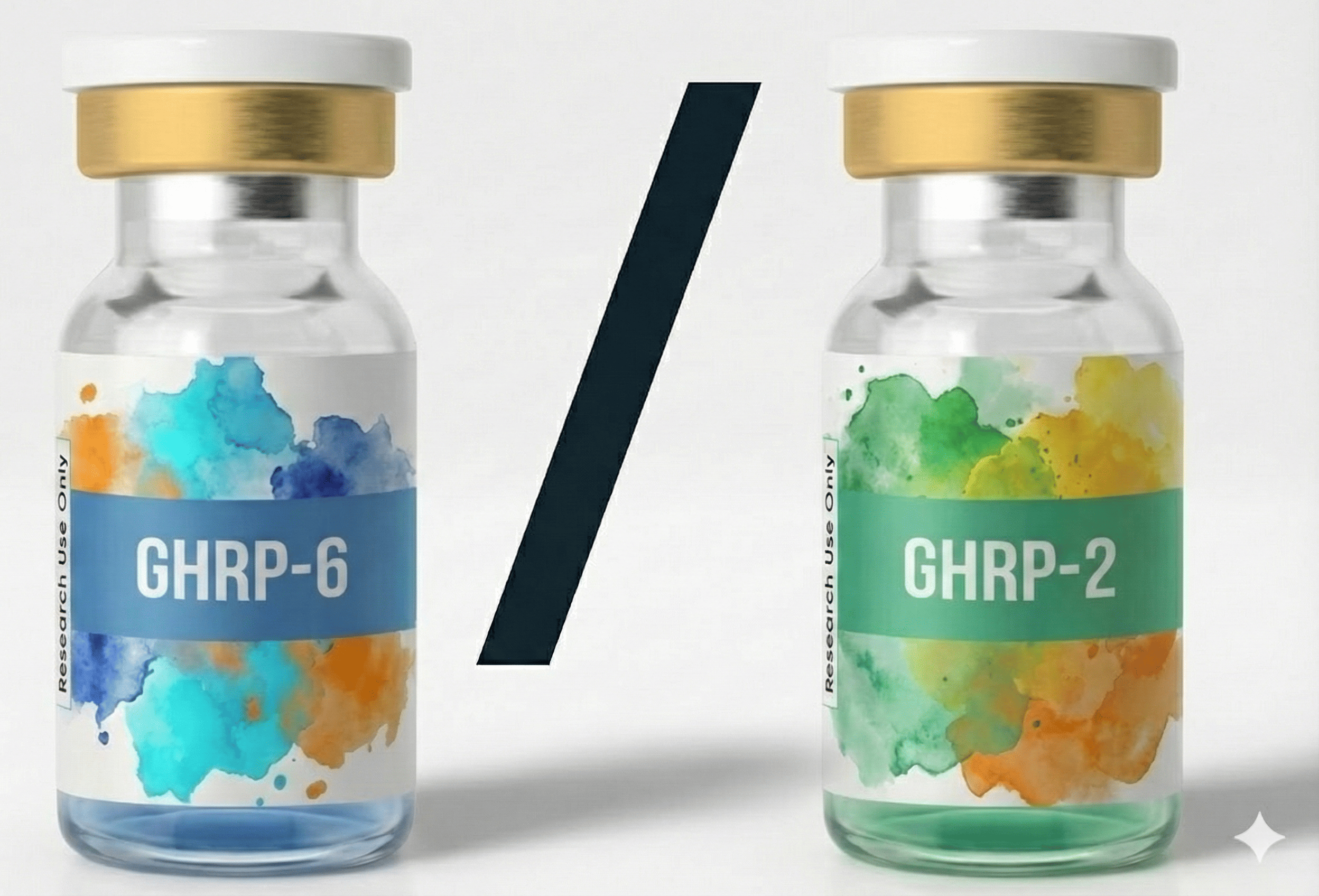
Peptide Profiles
Head-to-Head Comparison
| Property | GHRP-6 | GHRP-2 |
|---|---|---|
| Drug Class | Growth Hormone Releasing Peptide | Growth Hormone Releasing Peptide |
| Molecular Formula | C46H56N12O6 | C45H55N9O6 |
| Sequence Length | 6 amino acids | 6 amino acids |
| GH Release Potency | High | Highest among GHRPs |
| Appetite Stimulation | Very strong (ghrelin-like) | Moderate |
| Cortisol Increase | Significant | Mild to moderate |
| Prolactin Increase | Significant | Mild |
| Selectivity | Low (multiple effects) | Moderate (more selective) |
| Half-Life | ~20-30 minutes | ~20-30 minutes |
| Historical Status | First-generation GHRP | Second-generation GHRP |
Mechanism of Action Differences
GHRP-6 and GHRP-2 share the same primary mechanism—ghrelin receptor (GHS-R1a) activation—but differ in receptor binding characteristics and downstream effects.
GHRP-6: The Original Secretagogue
GHRP-6 was among the first synthetic GHRPs developed and retains many ghrelin-like properties:
- GHS-R1a Activation: Binds ghrelin receptor to stimulate pituitary GH release
- Intense Hunger: Strong ghrelin mimetic effect produces marked appetite increase within 20 minutes of administration
- Cortisol Release: Activates ACTH and cortisol release, which may reduce net anabolic benefit
- Prolactin Elevation: Increases prolactin levels, which may be undesirable in some research contexts
- Gastric Effects: Increases gastric motility consistent with ghrelin activity
GHRP-2: Improved Selectivity
GHRP-2 was developed as a more selective alternative:
- Higher GH Potency: Produces the strongest GH release among traditional GHRPs
- Reduced Hunger: Less intense appetite stimulation than GHRP-6, though still present
- Lower Cortisol: Reduced cortisol stimulation compared to GHRP-6
- Lower Prolactin: Less prolactin elevation, improving hormonal profile
- Still Non-Selective: Though improved, GHRP-2 still has off-target effects; Ipamorelin is more selective
Selectivity Spectrum: GHRP-6 (least selective) → GHRP-2 (moderate) → Ipamorelin (most selective). The evolution reflects efforts to isolate GH release from unwanted hormonal and appetite effects.
Comparative Efficacy Data
GH Release Comparison
Head-to-head and comparative studies show:
- GHRP-2: Produces the highest peak GH release among traditional GHRPs
- GHRP-6: Strong GH release but slightly lower peak than GHRP-2
- Dose Response: Both show dose-dependent GH release up to saturation
- Duration: Similar GH elevation duration (~2-3 hours)
Appetite Effects
A key differentiator between the peptides:
- GHRP-6: Produces intense, almost irresistible hunger 15-30 minutes post-injection; useful in appetite research but problematic for weight-conscious applications
- GHRP-2: Moderate appetite stimulation; noticeable but manageable
- Ipamorelin: Minimal appetite effect (for comparison)
Hormonal Profile
Off-target hormonal effects differ significantly:
- GHRP-6 Cortisol: Marked increase; may counteract anabolic GH effects
- GHRP-2 Cortisol: Mild increase; less metabolic interference
- GHRP-6 Prolactin: Significant elevation; potential concerns
- GHRP-2 Prolactin: Mild elevation; generally acceptable
Safety and Tolerability Profile
GHRP-6 Safety Profile:
- Hunger: Intense appetite may lead to overeating; problematic for weight management research
- Cortisol: Chronic elevation may produce stress-like metabolic effects
- Prolactin: May affect reproductive hormones and cause gynecomastia concerns
- Injection Site: Occasional redness or itching
- Water Retention: GH-related fluid retention possible
GHRP-2 Safety Profile:
- Better Tolerated: Reduced off-target effects improve overall tolerability
- Moderate Hunger: Less intense appetite stimulation than GHRP-6
- Hormonal Profile: Milder cortisol and prolactin effects
- Water Retention: Similar GH-related effects as GHRP-6
- Head Rush: Some reports of transient lightheadedness
General Consideration: Neither peptide has undergone comprehensive human safety trials. Both are research compounds, and long-term safety data is limited. For cleaner GH stimulation without these off-target effects, Ipamorelin is generally preferred.
Research Verdict: Power vs. Precision
Choose GHRP-6 When:
- Appetite stimulation is a desired research outcome
- Studying ghrelin pathway activation broadly
- Caloric intake increase is beneficial for the protocol
- Historical consistency with earlier research is required
Choose GHRP-2 When:
- Maximum GH release is the primary goal
- Appetite increase should be minimized but not eliminated
- Cortisol and prolactin effects should be reduced
- A balance between potency and selectivity is needed
Consider Ipamorelin When:
- Pure GH release without hormonal confounding is essential
- Appetite should not be affected
- Cleaner experimental design is required
Evolution of GHRPs: GHRP-6 → GHRP-2 → Ipamorelin represents the evolution toward more selective GH stimulation. GHRP-6's intense hunger effect is unique and valuable for specific research; GHRP-2 offers improved balance; Ipamorelin provides the cleanest GH signal. Choice depends on research objectives.
Frequently Asked Questions
Why does GHRP-6 cause more hunger than GHRP-2?
GHRP-6 more closely mimics natural ghrelin, the 'hunger hormone,' in its receptor binding profile. This produces intense appetite stimulation 15-30 minutes after injection. GHRP-2 was designed with modified binding characteristics that retain GH-releasing potency while reducing ghrelin-like hunger effects. However, GHRP-2 still causes some appetite increase; only Ipamorelin truly minimizes this effect.
Is GHRP-2 more effective than GHRP-6 for growth hormone release?
GHRP-2 produces slightly higher peak GH release than GHRP-6 and is considered the most potent of the traditional GHRPs. However, the difference is modest. GHRP-2's main advantage is its improved selectivity—achieving similar or better GH release with reduced cortisol, prolactin, and appetite effects compared to GHRP-6.
Should I choose GHRP-6 or GHRP-2 for research?
For most GH research purposes, GHRP-2 is preferred due to its higher potency and better selectivity. However, GHRP-6 is valuable when appetite stimulation is a desired outcome or when studying broad ghrelin pathway effects. For the cleanest GH research without hormonal or appetite confounding, Ipamorelin is generally recommended over both GHRP-6 and GHRP-2.
Do GHRP-6 and GHRP-2 cause receptor desensitization with repeated use?
Both peptides can produce some degree of GH response attenuation with continuous high-dose administration, though the extent varies. GHRP-6 appears more prone to desensitization at the ghrelin receptor due to its stronger ghrelin-mimetic binding profile. Research protocols typically mitigate this by using pulsatile dosing (2-3 times daily with intervals) rather than continuous infusion, and by cycling treatment periods. The desensitization pattern parallels what is observed with exogenous ghrelin administration.
Can GHRP-6 or GHRP-2 be combined with CJC-1295 for enhanced GH release?
Yes, both can be combined with CJC-1295 (a GHRH analog), and the combination produces synergistic GH release exceeding what either pathway achieves alone. However, Ipamorelin is generally preferred over GHRP-6 or GHRP-2 for combination protocols because its selectivity avoids the cortisol, prolactin, and appetite confounding that GHRP-6 and GHRP-2 introduce. If appetite stimulation or broad ghrelin pathway activation is specifically desired in the research context, GHRP-6 combined with CJC-1295 can be appropriate.
Citations & References
Bowers CY
Journal of Pediatric Endocrinology (1993)
Bowers CY, Momany FA, Reynolds GA, Hong A
Endocrinology (1984)
Cummings DE
Physiology & Behavior (2006)
Arvat E, di Vito L, Maccagno B, et al.
Peptides (1997)
Follow Peptpedia on Google
Add Peptpedia as a Preferred Source and Google can highlight our links with a "preferred" badge in your Top Stories and AI Overviews.