Sermorelin vs CJC-1295: GHRH Analog Comparison for Growth Hormone Research
Executive Summary
Sermorelin and CJC-1295 are both GHRH analogs that stimulate pituitary GH release through the GHRH receptor, but differ dramatically in pharmacokinetics. Sermorelin is the natural GHRH (1-29) fragment with a short half-life (~10-20 minutes), requiring frequent dosing but producing physiological pulsatile GH patterns. CJC-1295, particularly with DAC (Drug Affinity Complex), has an extended half-life (~8 days), allowing weekly dosing but producing more sustained GH/IGF-1 elevation. Sermorelin has FDA approval history for pediatric GH deficiency, while CJC-1295 remains a research compound with more limited clinical data.
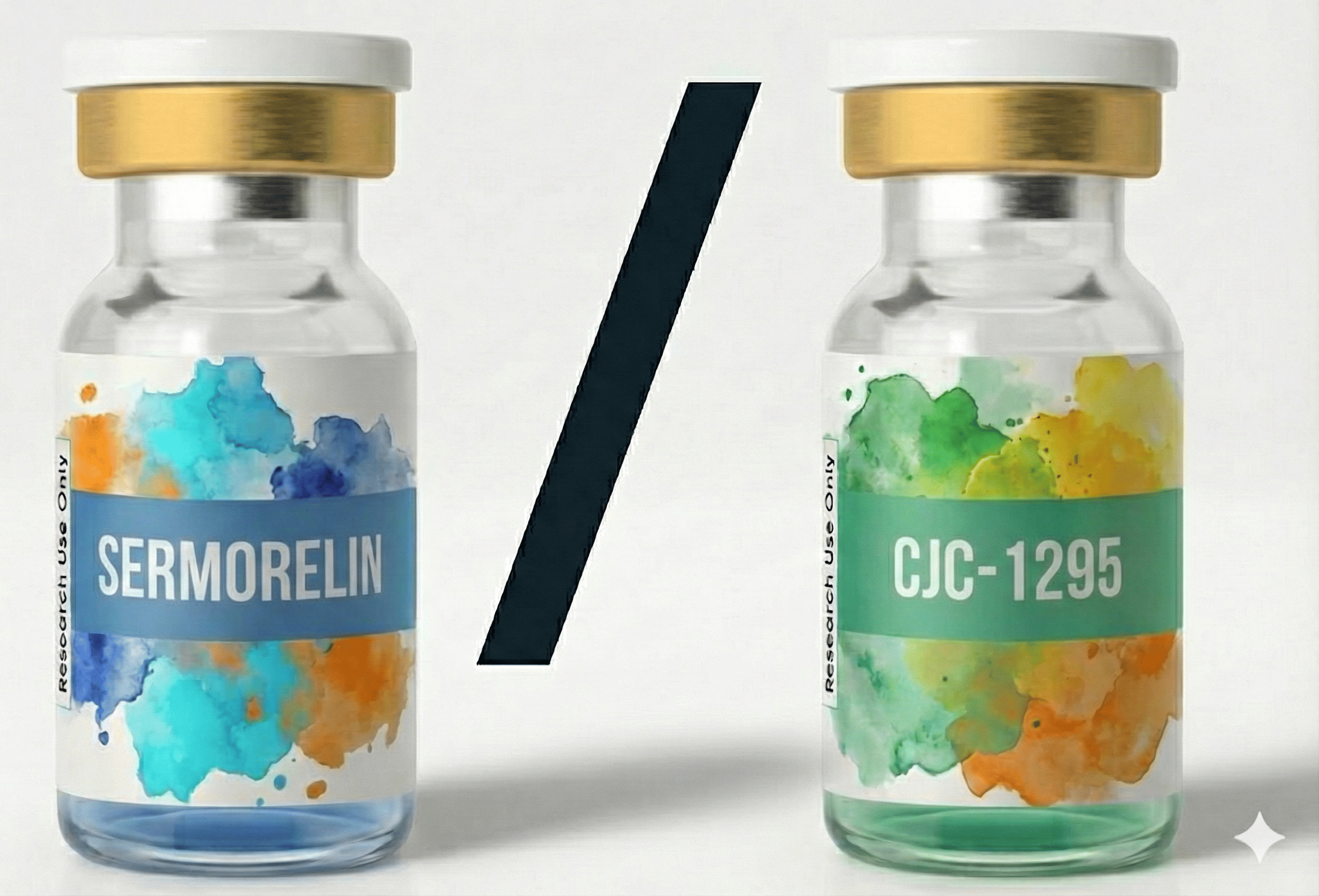
Peptide Profiles
Head-to-Head Comparison
| Property | Sermorelin | CJC-1295 |
|---|---|---|
| Drug Class | GHRH (1-29) Natural Fragment | Modified GHRH Analog |
| Molecular Formula | C149H246N44O42S | C152H252N44O42 |
| Sequence | GHRH amino acids 1-29 | Modified GHRH 1-29 with substitutions |
| Half-Life (Native) | ~10-20 minutes | ~30 minutes (without DAC) |
| Half-Life (Extended) | N/A | ~8 days (with DAC) |
| Dosing Frequency | Daily (often before bed) | Weekly (with DAC) or daily (without) |
| GH Pattern | Pulsatile (physiological) | Sustained elevation (with DAC) |
| FDA History | Previously approved (Geref) | No approval (research compound) |
| Clinical Data | Extensive (decades of use) | Limited (Phase 1/2 studies) |
| IGF-1 Effect | Modest, pulsatile | Sustained 2-3x elevation (with DAC) |
Mechanism of Action Differences
Sermorelin and CJC-1295 both activate the pituitary GHRH receptor but differ in their pharmacokinetic profiles and resulting GH patterns.
Sermorelin: Natural GHRH Fragment
Sermorelin is identical to the first 29 amino acids of natural human GHRH, retaining full biological activity:
- GHRH-R Activation: Binds and activates the GHRH receptor on pituitary somatotrophs
- Short Half-Life: Rapidly degraded by DPP-IV enzyme (~10-20 minute half-life)
- Pulsatile Release: Mimics natural GH secretion patterns with discrete pulses
- Physiological: Most closely resembles endogenous GHRH signaling
- Feedback Preserved: Normal negative feedback mechanisms remain intact
CJC-1295: Engineered Stability
CJC-1295 was designed to resist enzymatic degradation:
- Modified Sequence: Amino acid substitutions protect against DPP-IV degradation
- DAC Technology: Drug Affinity Complex binds covalently to endogenous albumin after injection, extending half-life to 5.8-8.1 days (PMID 16352683)
- Elevated Baseline: Raises trough (basal) GH roughly 7.5-fold while endogenous GH pulses persist in frequency and magnitude (PMID 17018654)
- Less Physiological: The elevated trough departs from natural secretion patterns, even though pulsatility itself is preserved
- Convenience: Weekly dosing with DAC form
Key Distinction: Sermorelin produces physiological pulsatile GH patterns on an unchanged baseline; CJC-1295 with DAC elevates the trough on which pulses ride. Whether sustained trough elevation is equivalent or superior to purely pulsatile exposure remains unresolved (PMID 17018654).
Comparative Clinical and Research Data
Sermorelin Clinical History
Sermorelin has the longest clinical history of any GHRH analog, anchored by the Prakash and Goa review (BioDrugs, 1999; PMID 18031173):
- Molecule: A 29-amino-acid GHRH analog — the shortest synthetic peptide retaining full GHRH biological activity
- Diagnostic Use: A single intravenous 1 μg/kg dose is a rapid and relatively specific provocative test for GH deficiency, producing fewer false-positive responses in non-deficient children than other provocative tests
- Pediatric Efficacy: Once-daily subcutaneous 30 μg/kg at bedtime produced significant height-velocity increases sustained through 12 months of treatment, with data in a subset of children suggesting maintenance through 36 months; catch-up growth occurred in the majority of GH-deficient children
- Tolerability: Well tolerated by intravenous and subcutaneous routes; transient facial flushing and injection-site pain were the most commonly reported adverse events
- FDA History: Marketed as Geref for diagnosis and treatment of pediatric GH deficiency; withdrawn from the US market in 2008 for commercial, not safety, reasons
CJC-1295 Research
CJC-1295 has fewer but well-controlled human studies, all using the DAC (albumin-binding) form:
- Phase 1 RCTs (Teichman et al., JCEM 2006; PMID 16352683): In healthy adults aged 21-61, a single subcutaneous injection produced dose-dependent GH increases of 2- to 10-fold sustained for 6 days or more and IGF-I increases of 1.5- to 3-fold for 9-11 days; estimated half-life was 5.8-8.1 days; after multiple doses, IGF-I remained above baseline for up to 28 days; no serious adverse reactions occurred, with best tolerability at 30 or 60 μg/kg
- Pulsatility Study (Ionescu and Frohman, JCEM 2006; PMID 17018654): After a single 60 or 90 μg/kg injection, GH pulse frequency and magnitude were unaltered, but basal (trough) GH rose 7.5-fold (P<0.0001), driving mean GH up 46% and IGF-I up 45% — continuous GHRH receptor stimulation elevates the baseline on which physiological pulses ride
- Proof of Concept (Alba et al., Am J Physiol 2006; PMID 16822960): In GHRH-knockout mice, once-daily CJC-1295 (2 μg) normalized body weight, body length, and femur/tibia growth and increased pituitary GH mRNA with immunohistochemical evidence of somatotroph proliferation; dosing every 48-72 hours was less effective
Comparative Considerations
Key differences in outcomes:
- Sermorelin: pediatric growth-outcome data (height velocity over 12-36 months) and decades of clinical exposure; requires daily dosing
- CJC-1295: adult pharmacology data with quantified GH/IGF-I responses (2-10x GH, 1.5-3x IGF-I) and weekly-to-biweekly dosing feasibility; no growth-outcome or long-term safety trials
- The pulsatility question is partly settled by the Ionescu data: CJC-1295 with DAC does not abolish GH pulses — it raises trough levels roughly 7.5-fold while pulses persist
Safety and Tolerability Profile
Sermorelin Safety Profile:
- Well-Characterized: Decades of clinical use provide extensive safety data
- Injection Site Reactions: Mild erythema or itching at injection site
- Flushing: Occasional facial flushing post-injection
- Headache: Reported in some patients
- FDA History: Previously FDA-approved; withdrawn for manufacturing, not safety reasons
CJC-1295 Safety Profile:
- Limited Long-Term Data: Less extensive than Sermorelin
- Flushing: More pronounced flushing reaction, especially with DAC form
- Water Retention: Possible fluid retention with sustained GH elevation
- Injection Site: Local reactions similar to other peptides
- Sustained IGF-1: Long-term effects of continuous IGF-1 elevation unknown
Comparative Safety: Sermorelin has the advantage of extensive clinical history and FDA approval precedent. CJC-1295's sustained IGF-1 elevation raises theoretical concerns about long-term effects that have not been evaluated in extended studies.
Research Verdict: Physiological vs. Practical
Choose Sermorelin When:
- Physiological pulsatile GH patterns on an unchanged baseline are the goal — Sermorelin stimulates discrete pulses without chronically elevating trough GH
- Growth-outcome data matter: 12-36 months of height-velocity data exist for Sermorelin in GH-deficient children (PMID 18031173); no equivalent dataset exists for CJC-1295
- Extensive safety data and prior FDA approval history are required
- Daily dosing is acceptable
Choose CJC-1295 When:
- Dosing convenience is paramount: a 5.8-8.1 day half-life supports weekly or biweekly injection (PMID 16352683)
- Sustained IGF-I elevation is the endpoint: IGF-I rose 1.5- to 3-fold for 9-11 days after a single dose and remained above baseline for up to 28 days with repeated dosing (PMID 16352683)
- Elevated basal GH with preserved pulsatility is acceptable — trough GH rose 7.5-fold while pulse frequency and amplitude persisted (PMID 17018654)
- The research question involves somatotroph recruitment: CJC-1295 increased pituitary GH mRNA and somatotroph proliferation in GHRH-knockout mice (PMID 16822960)
Practical Consideration: Many researchers use CJC-1295 without DAC (Modified GRF 1-29) combined with a GHRP such as ipamorelin, seeking stability benefits over Sermorelin while keeping GH exposure closer to physiological pulsatility and avoiding the 7.5-fold trough elevation documented with the DAC form (PMID 17018654).
Adult GHD Context: For adult-onset growth hormone insufficiency, Sermorelin has been evaluated as a secretagogue-based alternative to recombinant GH, with the caveat that its efficacy depends on intact pituitary somatotroph reserve (PMID 18046908). CJC-1295's clinical development was discontinued for business reasons rather than safety findings, leaving Sermorelin the only analog of the pair with a regulatory track record.
Frequently Asked Questions
Is CJC-1295 more effective than Sermorelin?
CJC-1295 produces higher sustained IGF-1 levels (2-3 fold elevation) compared to Sermorelin's more modest, pulsatile effects. However, 'effectiveness' depends on the goal. If physiological GH pulsatility is desired, Sermorelin may be superior. If sustained GH/IGF-1 elevation is the target, CJC-1295 (especially with DAC) achieves higher levels. The importance of pulsatility versus sustained elevation remains debated in the research community.
What is the difference between CJC-1295 with and without DAC?
CJC-1295 with DAC (Drug Affinity Complex) binds to serum albumin, extending its half-life from ~30 minutes to ~8 days. This allows once-weekly dosing but produces sustained, non-pulsatile GH/IGF-1 elevation. CJC-1295 without DAC (also called Modified GRF 1-29) requires more frequent dosing but produces a more pulsatile pattern. Many researchers prefer the no-DAC version combined with Ipamorelin for better balance between stability and physiological signaling.
Why was Sermorelin withdrawn from the market?
Sermorelin (Geref) was withdrawn from the US market in 2008 for manufacturing and business reasons, not safety concerns. The manufacturer chose not to continue production. Sermorelin remains available through compounding pharmacies for off-label use and is still considered safe based on decades of clinical experience. CJC-1295's development was similarly halted for business reasons unrelated to safety.
Citations & References
Prakash A, Goa KL
BioDrugs, 12: 139-57 (1999)
Teichman SL, Neale A, Lawrence B, et al.
The Journal of clinical endocrinology and metabolism, 91: 799-805 (2006)
Ionescu M, Frohman LA
The Journal of clinical endocrinology and metabolism, 91: 4792-7 (2006)
Alba M, Fintini D, Sagazio A, et al.
American Journal of Physiology-Endocrinology and Metabolism, 291: E1290-4 (2006)
Follow Peptpedia on Google
Add Peptpedia as a Preferred Source and Google can highlight our links with a "preferred" badge in your Top Stories and AI Overviews.