GHK-Cu vs BPC-157: Copper Peptide vs Gastric Peptide Comparison for Tissue Repair Research
Executive Summary
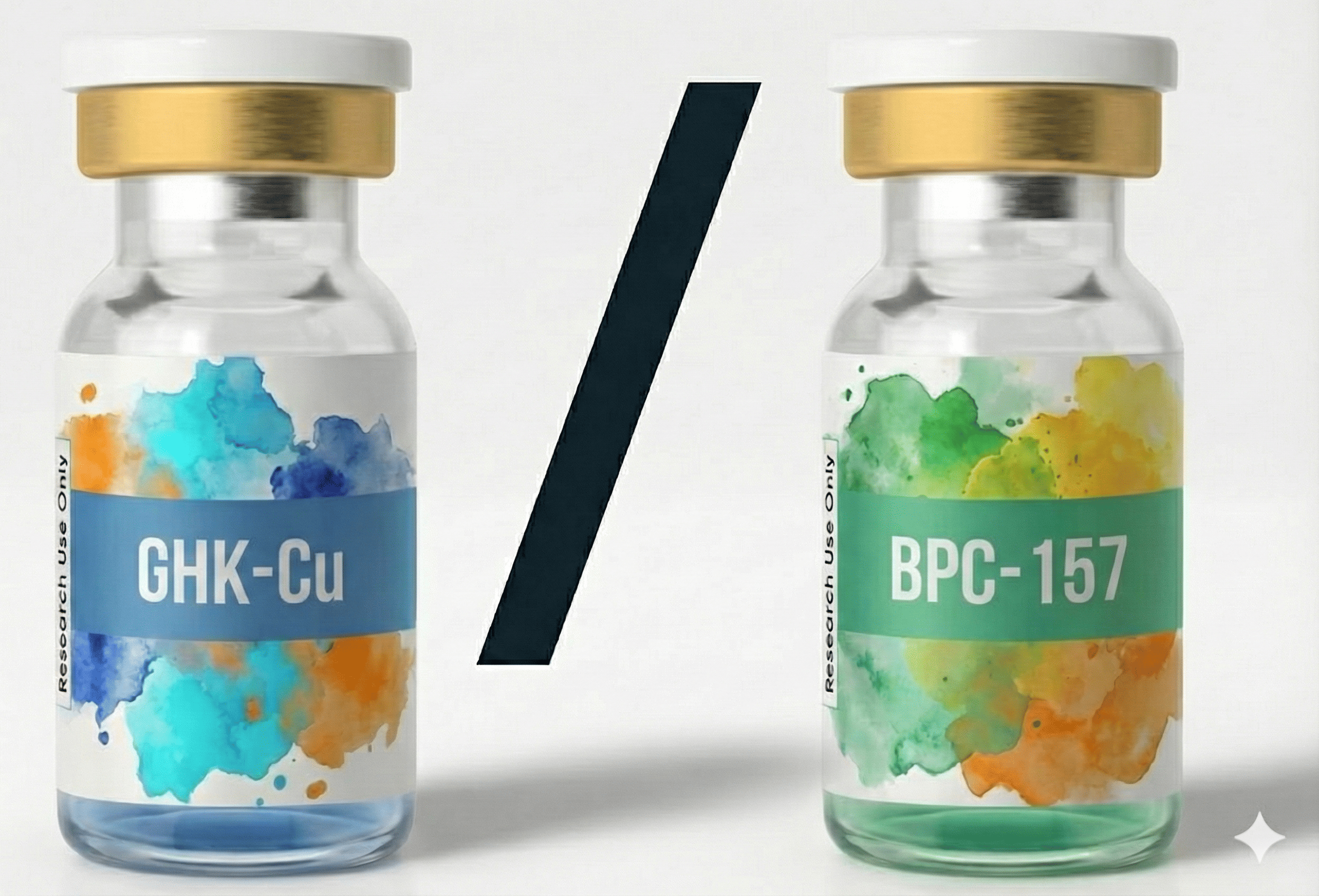
GHK-Cu and BPC-157 are two of the most researched peptides for tissue repair, with distinct but potentially complementary mechanisms. GHK-Cu, a naturally occurring copper-binding tripeptide, excels in skin rejuvenation, collagen remodeling, and topical wound healing through copper-dependent enzyme activation. BPC-157, a stable gastric pentadecapeptide, demonstrates broader systemic healing effects across multiple tissue types including tendons, muscles, and the gastrointestinal tract through angiogenic and growth factor pathways. GHK-Cu is well-suited for dermatological applications, while BPC-157 shows greater versatility for internal tissue repair.
Peptide Profiles
Head-to-Head Comparison
| Property | GHK-Cu | BPC-157 |
|---|---|---|
| Full Name | Glycyl-L-histidyl-L-lysine:copper(II) | Body Protection Compound-157 |
| Molecular Formula | C14H24CuN6O4 | C62H98N16O22 |
| Sequence | Gly-His-Lys (tripeptide) | 15 amino acids |
| Metal Cofactor | Copper (essential) | None |
| Natural Occurrence | Human plasma, saliva | Derived from gastric juice |
| Primary Focus | Skin, collagen, wound healing | Systemic tissue repair |
| Key Mechanism | Copper enzyme activation, gene modulation | VEGF/angiogenesis, NO system |
| Administration | Topical, subcutaneous | Oral, SC, IM, topical |
| Stability | Moderate (copper-dependent) | High (gastric stable) |
| Best Research Use | Dermatology, anti-aging | Musculoskeletal, GI healing |
Mechanism of Action Differences
GHK-Cu and BPC-157 promote tissue repair through fundamentally different biological pathways, reflecting their distinct origins and compositions.
GHK-Cu: Copper-Mediated Regeneration
GHK-Cu is a tripeptide that tightly binds copper(II) ions, and this copper complex is essential for its activity:
- Copper Enzyme Activation: Copper is a cofactor for enzymes including lysyl oxidase (collagen crosslinking), superoxide dismutase (antioxidant), and cytochrome c oxidase (cellular energy)
- Gene Expression Modulation: Alters expression of numerous genes related to matrix remodeling, anti-inflammation, and tissue repair
- Collagen Stimulation: Promotes synthesis of collagen types I, III, and elastin for skin firmness
- Matrix Metalloproteinase (MMP) Regulation: Modulates enzymes that break down and remodel extracellular matrix
- Anti-inflammatory: Reduces inflammatory cytokines and oxidative stress
BPC-157: Growth Factor and Vascular Healing
BPC-157 works through vascular and growth factor pathways:
- Angiogenesis: Potently upregulates VEGF (vascular endothelial growth factor) to form new blood vessels at injury sites
- Nitric Oxide Modulation: Interacts with NO system for vasodilation and tissue protection
- Growth Factor Expression: Increases EGF, FGF, and other growth factors supporting multiple tissue types
- Cytoprotection: Protects cells from various toxic insults
- Nerve Regeneration: Promotes healing of peripheral nerve injuries
Complementary Potential: GHK-Cu's collagen/matrix focus complements BPC-157's vascular/growth factor approach. Topical GHK-Cu for skin combined with systemic BPC-157 for deeper tissues represents a potential synergistic strategy.
Comparative Research Efficacy Data
GHK-Cu Research Evidence
GHK-Cu's evidence base is anchored by gene-expression profiling and regenerative reviews from Pickart and colleagues:
- Gene Expression Reset: GHK modulates genes tied to inflammation, tissue destruction, and repair — suppressing fibrinogen synthesis while activating the ubiquitin-proteasome system, DNA repair, antioxidant systems, and TGF-beta superfamily healing pathways; in cells from cancer and COPD patients, GHK shifted gene activity back toward a healthier state (PMID 25302294)
- Multi-Tissue Repair: Repair effects demonstrated for skin, lung connective tissue, boney tissue, liver, and stomach lining, alongside stimulation of blood vessel and nerve outgrowth and increased collagen, elastin, and glycosaminoglycan synthesis (PMID 29986520)
- Skin Regeneration: Modulates multiple cellular pathways in skin, including collagen and decorin synthesis, matrix remodeling, and anti-inflammatory and antioxidant actions (PMID 26236730)
- Age-Related Decline: Plasma GHK declines with age, paralleling the age-related rise in inflammatory and tissue-destructive gene activity and the fall in regenerative gene activity (PMID 25302294)
- Hair and Burns: Stimulated hair follicle activity and improved outcomes in experimental burn models
BPC-157 Research Evidence
BPC-157 demonstrates broader tissue healing with a defined molecular handle:
- Tendon Mechanism: In rat Achilles tendon fibroblasts, BPC-157 dose- and time-dependently upregulated growth hormone receptor (GHR) at both mRNA and protein levels; subsequent growth hormone exposure increased cell proliferation and activated JAK2, the downstream GHR signaling pathway — suggesting BPC-157 sensitizes tendon tissue to endogenous growth hormone (PMID 25415472)
- Wound and Fistula Closure: A 2021 review documents closure of skin defects and both external and internal fistulas (esophagocutaneous, gastrocutaneous, duodenocutaneous, colocutaneous, colovesical, rectovaginal) in rat models at 10 μg/kg or 10 ng/kg given intraperitoneally or orally in drinking water, with the beneficial effect maintained under NO-system manipulation (PMID 34267654)
- Gastrointestinal: Anti-ulcer activity across esophagus, stomach, duodenum, intestine, liver, and pancreas lesion models; healed intestinal anastomoses and fistulas even when therapy was postponed for one month; stable in human gastric juice with no reported toxicity (PMID 21548867)
- Vascular Effects: Strong angiogenic potential, endothelial protection, and prevention and reversal of thrombus formation after abdominal aorta anastomosis (PMID 21548867)
- Muscle, Nerve, Bone: Enhanced recovery from crush injuries, improved sciatic nerve regeneration, and accelerated fracture healing in animal studies
Application Differences
Research suggests distinct optimal applications:
- GHK-Cu: Best for skin aging, superficial wounds, dermatological conditions; the evidence is mechanistic and gene-expression focused with cosmetic-use human exposure
- BPC-157: Best for deep tissue injuries, musculoskeletal damage, GI healing; the evidence is overwhelmingly preclinical but spans more organ systems
- Neither peptide has completed Phase 3 clinical trials for these indications; BPC-157's human exposure is limited to the early inflammatory bowel disease trial experience referenced in the literature (PMID 21548867)
Safety and Tolerability Profile
GHK-Cu Safety Profile:
- Natural Compound: Occurs naturally in human plasma, suggesting inherent biocompatibility
- Topical Use: Well-established safety in cosmetic/dermatological products
- Copper Considerations: Systemic copper levels should be monitored with injected use
- Low Toxicity: No significant toxicity reported in available research
- Commercial Products: Available in FDA-compliant cosmetic formulations
BPC-157 Safety Profile:
- Gastric Origin: Derived from naturally occurring gastric protein
- Remarkably Low Toxicity: No LD50 established; very high safety margin in animal studies
- No Hormonal Effects: Does not affect testosterone, estrogen, or other hormonal axes
- Gastric Stability: Unusual stability allows oral administration
- Limited Human Data: No comprehensive human safety trials completed
Comparison: GHK-Cu has more established safety data through cosmetic use but less systemic exposure data. BPC-157 has broader animal safety data but less human exposure history. Both appear safe in available research.
Research Verdict: Surface vs. Deep Healing
Choose GHK-Cu When Research Focuses On:
- Skin wound healing, regeneration, and anti-aging dermatology — the domain where its collagen, elastin, and glycosaminoglycan synthesis data are strongest (PMID 29986520, PMID 26236730)
- Matrix remodeling requiring decorin synthesis or MMP regulation
- Topical application and cosmetic-formulation contexts, where human exposure data already exist
- Models of age-related gene dysregulation: GHK shifted gene expression in cancer and COPD patient cells toward healthier patterns and activated DNA repair and proteasome pathways (PMID 25302294)
Choose BPC-157 When Research Focuses On:
- Tendon and ligament injuries, where a defined mechanism — growth hormone receptor upregulation that sensitizes fibroblasts to growth hormone via JAK2 — has been demonstrated experimentally (PMID 25415472)
- Gastrointestinal healing, including ulcer, anastomosis, and fistula models that closed even when therapy was delayed one month (PMID 21548867)
- Complex wound scenarios involving nitric oxide system interaction, where efficacy persisted under L-NAME and L-arginine manipulation (PMID 34267654)
- Oral or systemic administration, enabled by unusual stability in human gastric juice (PMID 21548867)
Combination Consideration: The two peptides target different phases of repair — GHK-Cu's matrix remodeling and gene-expression modulation versus BPC-157's angiogenesis and growth-factor-receptor sensitization. For injuries spanning skin and deeper structures, the pairing is mechanistically rational: BPC-157 restores blood supply and deep-tissue integrity while GHK-Cu rebuilds the dermal matrix. No published study has evaluated combined use, so synergy remains untested.
Evidence Quality Note: Both evidence bases are preclinical-weighted. GHK-Cu's human data derives largely from cosmetic dermatology use, while much of BPC-157's wound-healing literature originates from a single research group's rat models (PMID 34267654), with independent mechanistic support from work such as the tendon fibroblast GHR study (PMID 25415472). Neither peptide has Phase 3 efficacy data, and research conclusions should be weighted accordingly.
Frequently Asked Questions
Can GHK-Cu and BPC-157 be used together?
GHK-Cu and BPC-157 target different healing pathways and may be complementary. GHK-Cu focuses on collagen synthesis and matrix remodeling through copper-dependent mechanisms, while BPC-157 promotes healing through angiogenesis and growth factor pathways. For injuries involving both skin and deeper tissues, combination protocols may theoretically provide more comprehensive healing. However, no formal research has evaluated combined use.
Which is better for wound healing: GHK-Cu or BPC-157?
The choice depends on the wound type. GHK-Cu is particularly well-suited for superficial skin wounds and surgical incisions due to its collagen-stimulating and matrix-remodeling effects. BPC-157 may be better for deeper injuries involving tendons, muscles, or internal tissues due to its angiogenic effects and broader tissue healing capabilities. For complex wounds, both may have complementary roles.
Is GHK-Cu safe to use since it contains copper?
GHK-Cu occurs naturally in human plasma at measurable concentrations, suggesting inherent biocompatibility. For topical use, GHK-Cu has an excellent safety record in cosmetic products. For systemic use (injection), copper levels should be monitored, particularly with long-term administration. The copper in GHK-Cu is tightly bound and serves as an essential cofactor for the peptide's healing mechanisms rather than acting as free copper.
Citations & References
Pickart L, Margolina A
BioMed Research International (2015)
Sikiric P, Seiwerth S, Rucman R, et al.
Current Pharmaceutical Design, 17: 1612-32 (2011)
Pickart L, Vasquez-Soltero JM, Margolina A
BioMed Research International, 2014: 151479 (2014)
Pickart L, Margolina A
International Journal of Molecular Sciences, 19 (2018)
Chang CH, Tsai WC, Hsu YH, Pang JH
Molecules, 19: 19066-77 (2014)
Follow Peptpedia on Google
Add Peptpedia as a Preferred Source and Google can highlight our links with a "preferred" badge in your Top Stories and AI Overviews.